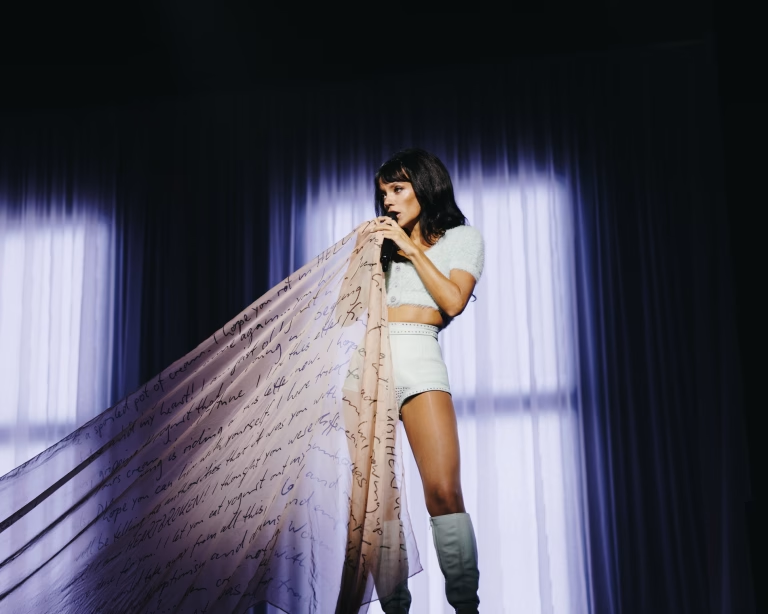
When Lily Allen brought West End Girl to The Met in Philadelphia earlier this year, the show felt almost too intimate to call a concert. It was a one-woman theater production disguised as a pop show, with Allen moving through the wreckage of a relationship surrounded by a bed, a sofa, a refrigerator and little else.
Six months later, the production has grown considerably. But somehow, it hasn’t lost what made it so effective.
Taking West End Girl to Philadelphia’s TD Pavilion at Highmark Mann on September 6, Allen brought the same story to a much larger stage, proving that intimacy doesn’t necessarily require a small room. The result was still less like a traditional concert and more like watching a West End production unfold in front of thousands of people..
Allen’s West End Girl tour began March 2 at Glasgow Royal Concert Hall, marking her first concert in seven years. What began with a run of intimate theater dates has expanded into Allen’s biggest headline tour yet, moving through larger venues across the United Kingdom, North America, Australia and New Zealand before its scheduled conclusion in Perth on November 1.
Philadelphia has now seen two very different versions of the same show.
At The Met, Allen had roughly 3,500 people packed into an opera house. At the Mann, she had an outdoor amphitheater and a dramatically larger stage at her disposal. Yet rather than turning West End Girl into a spectacle, Allen continued to treat the album like a play.
The stage, designed by Anna Fleischle, remained the center of the story. The familiar domestic setting of the album was expanded for the larger venue, but the props still served the same purpose. The bed, sofa and refrigerator weren’t simply pieces of set decoration. They were characters in the story, appearing and disappearing as Allen moved through the album’s increasingly complicated emotional landscape.
And that is what makes this production so unusual.

There are no traditional concert tricks needed to make the show work. No elaborate band setup. No constant crowd interaction. No attempt to squeeze “Smile,” “The Fear” or “Not Fair” into the set simply because they are the songs audiences might expect to hear.
Instead, Allen performs West End Girl in its entirety, in the order it appears on the album, allowing the record’s narrative to dictate the evening. The Highmark Mann itself describes the performance as Allen bringing the album to life in full and in sequence on a larger-than-ever stage.
“West End Girl” once again served as the opening statement, immediately establishing the world Allen has created. Under the lights, the title appeared above her as she stepped into the character at the center of the story.
From there, the night moved through open marriage, jealousy, betrayal, denial and eventual self-realization.
“Ruminating” remained one of the show’s emotional anchors. Allen lets the tension sit in the room before eventually moving into the sharper humor of “Madeline.” That transition is one of the reasons the production works so well. West End Girl is deeply personal, but Allen never allows the evening to become completely miserable.
“Pussy Palace” remains one of the biggest examples. Allen turns the bed into part of the performance, using props to bring the song’s absurdity to life. What could easily become an incredibly dark moment instead becomes funny, uncomfortable and strangely cathartic.
That distinction is important because West End Girl is ultimately a record about taking control back.
By the time Allen reaches “Let You W/in” and “Fruityloop,” the story has traveled a long way from where it began. The anguish hasn’t disappeared, but it has transformed into something closer to acceptance.
“I’ve already let you in. All I can do is sing. So why should I let you win?”
The line lands differently in a venue this large.
At The Met, it felt like Allen was speaking directly to a room of people sitting just feet away. At the Mann, thousands of people heard it at once. Yet the emotion somehow remained personal.
The Mann is designed for big concerts. It is a place where artists can fill a stage with lights, musicians, screens and spectacle. Allen instead takes a story built around heartbreak and places it in the middle of one of Philadelphia’s larger outdoor stages, trusting the material to carry the night.
Before Allen appeared, the Dallas Minor Trio once again provided the bridge between the Lily Allen of the past and the Lily Allen of West End Girl. The trio performed instrumental versions of Allen’s older hits, with lyrics projected for the audience. What began as a clever theatrical device during the original theater run has become an almost necessary part of the experience, giving longtime fans a chance to revisit the songs they know while Allen prepares to tell an entirely different story.
The result is an unusual compromise between concert and theater.
For fans who came hoping for a greatest-hits show, the Dallas Minor Trio provides a nostalgic appetizer. For everyone else, it reinforces the idea that West End Girl is meant to be experienced as one complete piece.
Allen has now spent months living inside this story. What started in Glasgow in March has traveled across continents, eventually landing on stages much larger than the intimate theaters where the production began.
And Philadelphia’s second encounter with the show makes it clear that the production hasn’t simply gotten bigger, its better than ever.
The tour continues across North America before moving to Australia and New Zealand, with the current schedule set to conclude November 1 at RAC Arena in Perth.